WR-PN-002
Pattern Encoding
Structure accumulating through repetition, variation, and local interaction.
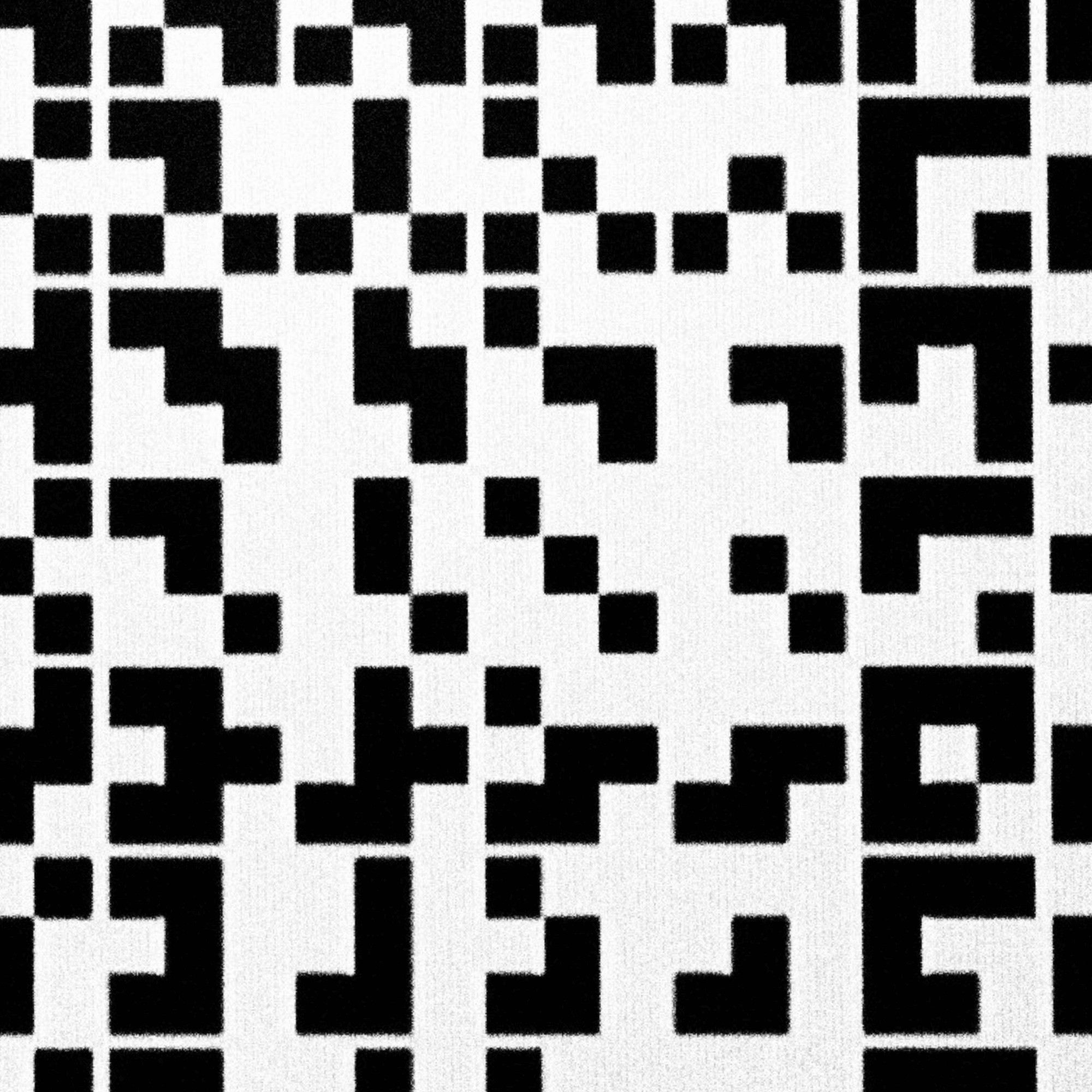
This work begins as a simple system: a 3 × 3 grid of discrete units, each either filled or empty. After a conversation around Random Order, I became interested in asking AI to generate a similar structure — something governed by simple rules, but open to variation.
A finite combinatorial logic underpins the structure: a system capable of producing 512 possible configurations, though here this possibility space is only partially explored. By introducing small shifts — removals, interruptions, uneven densities — the surface moves away from uniformity. Rather than designing specific compositions, the process becomes one of observing how local changes accumulate.
Patterns begin to suggest themselves: clusters, alignments, densities — but never fully resolve into a fixed structure. The eye searches for meaning, reading fragments as symbols, codes, or signals, though no single interpretation holds.
What emerges sits somewhere between image and language: a field that feels encoded, but remains open. Order is distributed, formed through repetition and deviation rather than imposed hierarchy.