About
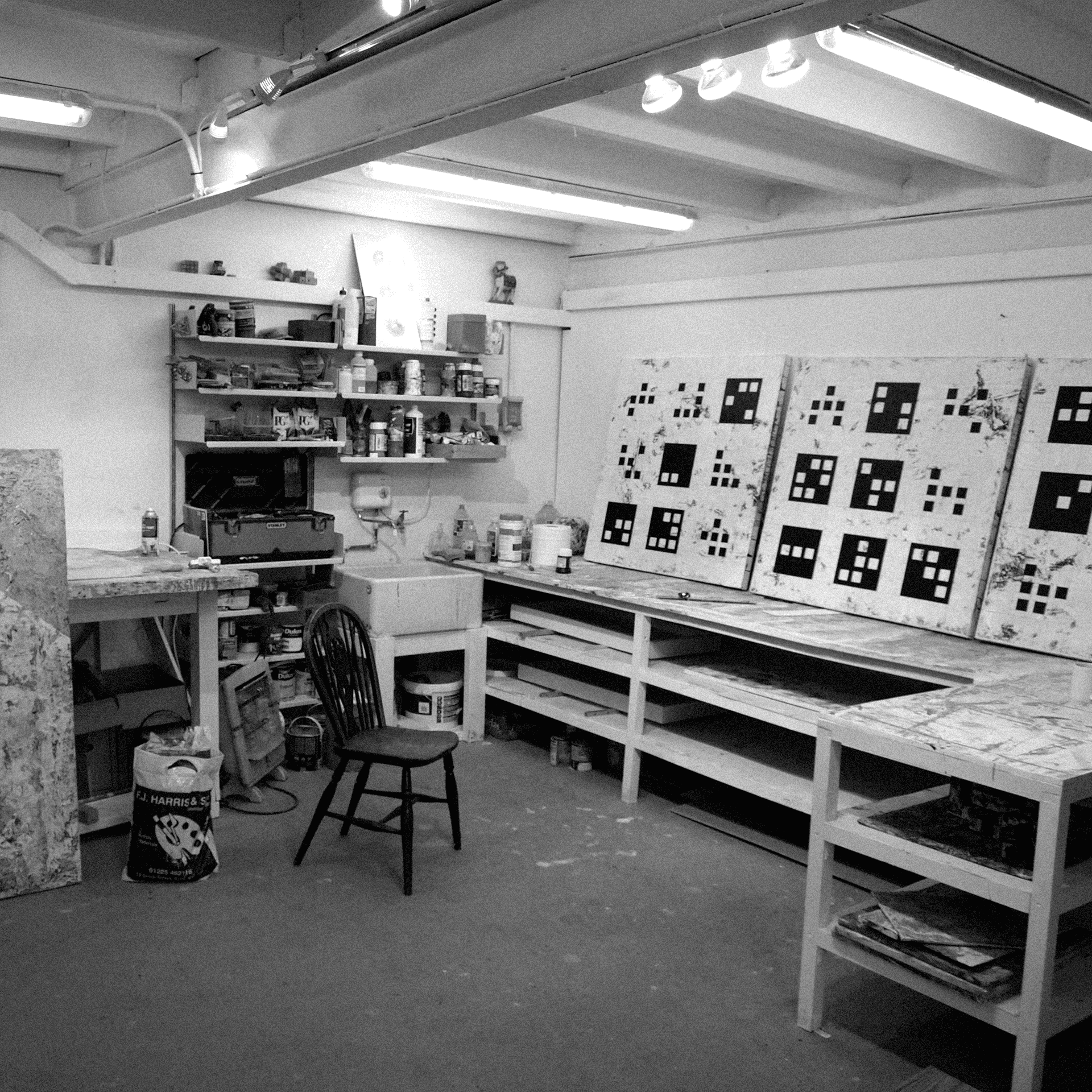
Will Reardon’s practice examines the aesthetics of emergence.
His work focuses on the recurring geometries that structure both natural systems and human cognition — fractal cracks in dried earth, stellar dispersions, infrastructural grids, and microscopic cellular formations.
Rather than presenting these patterns as evidence of harmony, Reardon interrogates the human impulse to interpret them. The works hover between recognition and ambiguity, inviting viewers to confront their own pattern-seeking tendencies. In this way, the practice operates as both formal investigation and psychological inquiry.
Reardon is particularly interested in scale: how similar structures recur across orders of magnitude. These repeating forms suggest an underlying continuity — a universal order that links the microscopic, the natural, and the cosmic, and echoes in patterns of human thought.
Materially, the work often incorporates layered surfaces, modular construction, and digitally informed processes. Systems are established and then disrupted. Precision gives way to fracture. The tension between structure and entropy remains unresolved.
Reardon lives and works in the United Kingdom.
His work focuses on the recurring geometries that structure both natural systems and human cognition — fractal cracks in dried earth, stellar dispersions, infrastructural grids, and microscopic cellular formations.
Rather than presenting these patterns as evidence of harmony, Reardon interrogates the human impulse to interpret them. The works hover between recognition and ambiguity, inviting viewers to confront their own pattern-seeking tendencies. In this way, the practice operates as both formal investigation and psychological inquiry.
Reardon is particularly interested in scale: how similar structures recur across orders of magnitude. These repeating forms suggest an underlying continuity — a universal order that links the microscopic, the natural, and the cosmic, and echoes in patterns of human thought.
Materially, the work often incorporates layered surfaces, modular construction, and digitally informed processes. Systems are established and then disrupted. Precision gives way to fracture. The tension between structure and entropy remains unresolved.
Reardon lives and works in the United Kingdom.
Will Reardon’s practice examines the aesthetics of emergence.
His work focuses on the recurring geometries that structure both natural systems and human cognition — fractal cracks in dried earth, stellar dispersions, infrastructural grids, and microscopic cellular formations.
Rather than presenting these patterns as evidence of harmony, Reardon interrogates the human impulse to interpret them. The works hover between recognition and ambiguity, inviting viewers to confront their own pattern-seeking tendencies. In this way, the practice operates as both formal investigation and psychological inquiry.
Reardon is particularly interested in scale: how similar structures recur across orders of magnitude. These repeating forms suggest an underlying continuity — a universal order that links the microscopic, the natural, and the cosmic, and echoes in patterns of human thought.
Materially, the work often incorporates layered surfaces, modular construction, and digitally informed processes, with roots in motion graphics. Systems are established and then disrupted. Precision gives way to fracture. The tension between structure and entropy remains unresolved.
Reardon studied at Goldsmiths, University of London, and lives and works in the United Kingdom.